Oshen triples production of ocean-sailing robots to close the planet's biggest blind spot
Posted
Oshen, the British robotics company building a persistent sensing layer for the world’s oceans, is tripling its manufacturing rate to meet demand from navies, weather agencies and ocean scientists. Its swarms of one-metre wind-and solar powered vessels deliver real-time ocean intelligence for security, climate and infrastructure.
Navies procure a handful of billion-dollar ships in single digits over decades and spend much of their time tracking submarine activity across the North Atlantic. Oshen’s bet is that the job needs the opposite – thousands of cheap, expendable, mass-produced robots, built like compute hardware, at sea.
Oshen’s customers and partners now include the US Navy’s Naval Meteorology and Oceanography Command, the Royal Navy, NOAA, the Met Office, Météo-France and VOTO, the Swedish ocean-monitoring body. Its C-star production has scaled to match. The company initially took three years to build its first 15 C-Stars, and now builds 15 every six weeks with a standardising system that allows a new technician to assemble parts in less than half an hour so it can be replicated at multiple sites.
One hundred more are on order as demand increases across both of the C-star’s missions. In security, they keep a persistent, low-cost watch in waters where sanctioned oil moves on ships with transponders switched off, uncrewed vehicles operate near cables and pipelines that carry power and data, and where vessels strip fish stocks and run narcotics where no one is watching. In weather, where the ocean’s heat is badly under-measured, better surface data means a hurricane’s rapid intensification is flagged earlier and evacuations start sooner. As constellations of C-stars grow the data will improve seasonal forecasts and, in time, climate projections.
“We’re making the ocean’s eyes and ears, and we need a lot of them,” said Anahita Laverack, CEO and co-founder of Oshen. “Seventy per cent of the planet is ocean and we can barely see any of it in real time. That’s not a sensing problem any more – the technology works, and it works in the worst conditions on Earth. It’s a manufacturing problem. So we’ve spent the last year turning C-Star production into something closer to a fast-food kitchen than a shipyard: fast, repeatable, and something you can stand up anywhere.”
The company has grown from seven people in September 2025 to almost 30 today. Supporting the expansion is a new $5 million round led by Lunar Ventures, with participation from AlbionVC, Twin Track and Concept Ventures, alongside angel investors joining as advisors. The funding will go into scaling manufacturing and into three technical areas where customer demand is growing fastest: passive acoustics for ship detection, protection of subsea critical infrastructure, and anti-submarine warfare.
Proven in the ocean’s harshest conditions
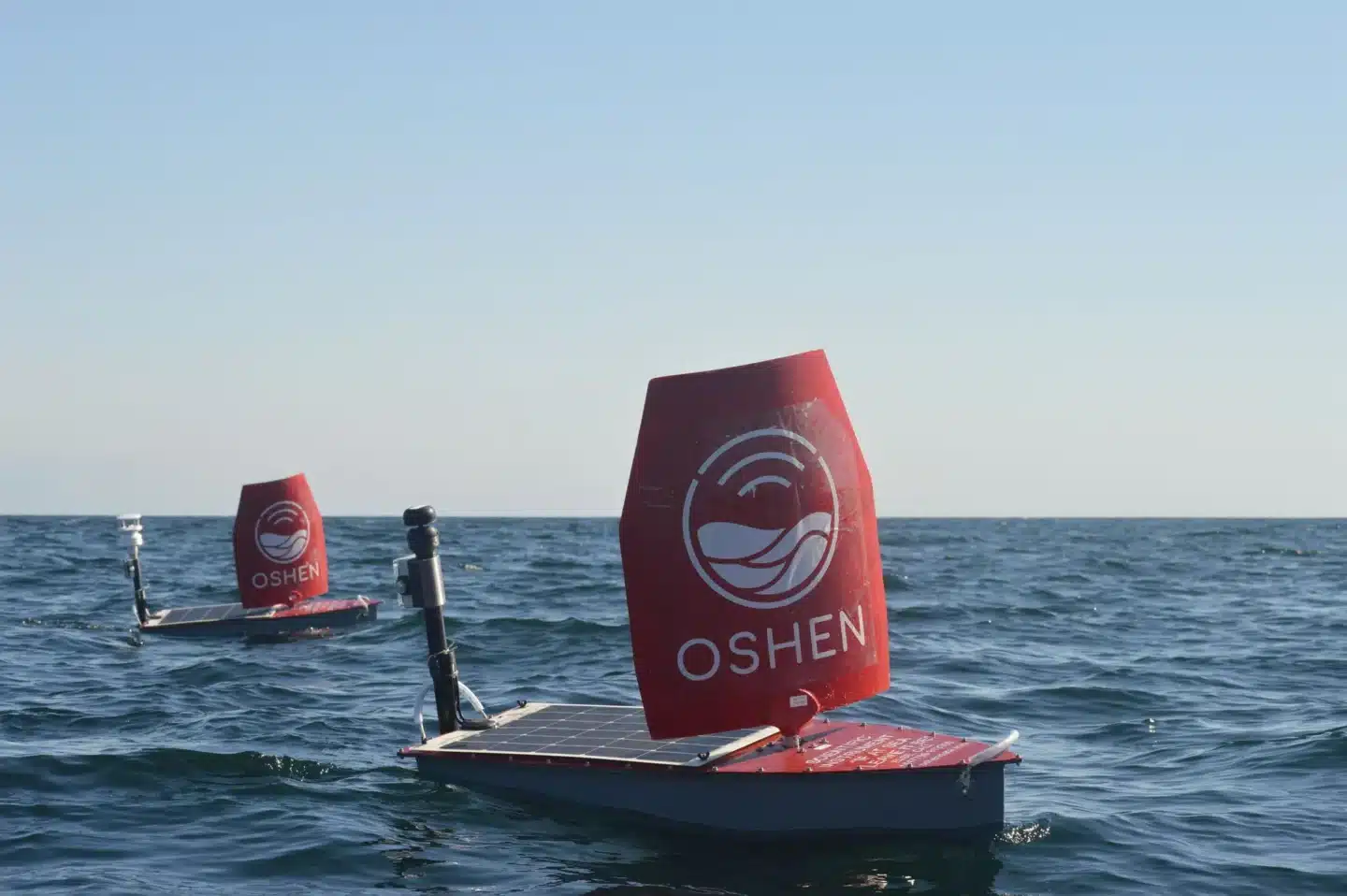
C-Stars are 1.2-metre, wind-and-solar robots designed to be picked up by one person and thrown over the side of any boat. They sail for months without maintenance, transmitting data by satellite, and operate in constellations: dozens of small craft spread across hundreds of miles of sea, dispersing for wide-area coverage or converging on a single area of interest.
In September 2025, working under contract with the US National Oceanic and Atmospheric Administration (NOAA), three C-Stars intercepted Hurricane Humberto north of St Thomas in the Caribbean, penetrating the eyewall while the storm was rated Category 5. This is a first for any uncrewed surface vessel, reporting live data every two minutes through 30-foot waves and gusts strong enough to destroy its own wind sensor. The data fed into the National Hurricane Center’s official forecast discussion.
Oshen’s longest single mission to date is eight months at sea, and its constellations have operated across six countries sold across three models: data as a service, vessel leases, and outright constellation sales.
From forecasting to defence
Oshen works with the US Navy’s Naval Meteorology and Oceanography Command under a Cooperative Research and Development Agreement, integrating Navy-selected sensors into the C-Star platform for shallow-water survey. In a separate project backed by the UK’s Defence and Security Accelerator, C-Stars are being trialled as a distributed passive acoustic network alongside ZeroUSV and MarineAI, including a world first in which C-Stars were autonomously launched at sea from an uncrewed mothership.
Oshen is also deploying a 50-strong constellation in the North Atlantic Subpolar Gyre under a £2 million project funded by the Advanced Research and Invention Agency (ARIA), building an early-warning system for one of the climate system’s most consequential tipping points.
“There is a version of the next decade where the ocean stops being a dark spot,” said Laverack. “Not because of one clever sensor, but because there are thousands of cheap robots out there, all the time, telling us what’s actually happening. This is our goal at Oshen. We’ve done step 1 — make world-class robots that have achieved world firsts — now it’s time to see the impact a hundred of them can have.”
“Governments and public institutions increasingly depend on reliable information about the oceans to improve weather forecasting, protect critical infrastructure and strengthen maritime security. Until recently, persistent ocean observation relied on a handful of expensive platforms that could only sample a fraction of the domain. Advances in autonomy and manufacturing are making it possible to replace scarcity with scale. Oshen is among the first companies turning that shift into operational reality.” says Mick Halsband, General Partner at Lunar Ventures.
Related content
geoSurge launches free app showing brands how they rank in ChatGPT, Claude and Gemini
The app tracks AI visibility and share of voice by topic, country and model, running on the AI plan brands already pay for.