UK EnergyTech Report
Adam Chirkowski (AlbionVC) Henry Whorwood, Miraj Mistry, and Blanca Valencia (Beauhurst)
Report sections:
Energy ecosystem in numbers
EnergyTech companies for the purposes of this report are software/AI native businesses that develop and sell solutions designed for the operation, optimisation, trading, decarbonisation or management of energy assets and energy markets. The focus is on the asset-lite section of the space where software or AI is the predominant value proposition (even if alongside physical assets). This therefore removes the likes of the physical infrastructure players along with some of the more deep technologies such as fusion, hydrogen, advanced materials, and advanced storage solutions. Also not included are mobility companies and the EV space in general.
This report covers startups in the ecosystem incorporated on or after 1st January 2016. It does not
seek to break the space down into its constituent parts in a market mapping exercise but rather
serves to give an overall view of the market.
Energy is the defining constraint and enabler of global
AI and compute:
£1bn
Raised by UK energy tech startups since 2016 across 483 rounds
66%
of first time deals went to AI-led energy tech companies in 2025
2x
Data centre power demand to more than double by 2030 (IEA)
Introduction
The cost of the electron will define
the next decade.
One of the most consequential topics of today, connected to most material economic conversations, concerns the cost of the electron; the energy required not just to run the compute on which AI capability now depends, but also the price of electricity flowing through every industrial customer, underpinning every business and impacting every household. In the decade ahead, the cost of energy will define competitiveness for everyone from SMEs to corporations and their investors, through to nations on the global stage. For UK national interest it is vital that the topic does not pass us by.
The world’s energy system is undergoing disruption unlike anything seen in over a century. As the energy transition turns the traditional model on its head, we are moving from centralised generation to a decentralised, highly fragmented and more variable model powered by thousands of distributed energy resources. With it comes an exponential rise in the complexities of how the system needs to operate.
Against this backdrop, two major events over the past 5 years have brought the importance of energy front and centre, providing the catalyst for innovation and driving the acceleration of technology start-ups building in the space.
First came the energy crisis that followed Russia’s invasion of Ukraine in February 2022 which sent European gas and electricity prices to extreme highs. The volatility that followed exposed the impact of geopolitical events, on seemingly unconnected domestic P&Ls. Energy underpins almost everything businesses of all sizes do, and when the bills started soaring that reality became more tangible than ever.
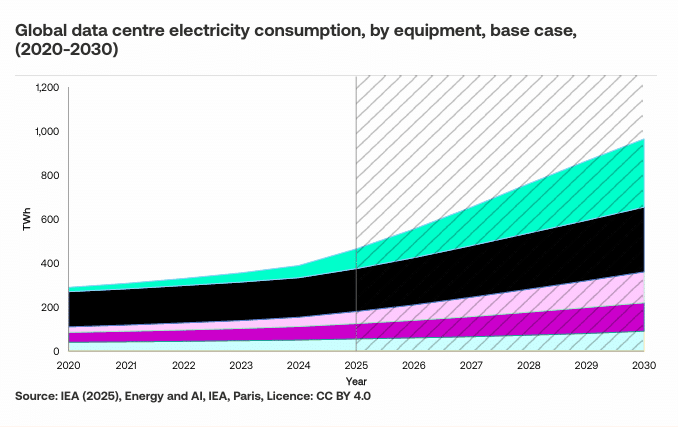
Annual renewable capacity additions across Europe almost doubled from 2021 to 2023 as nations raced to build domestic supply to try and insulate from such shocks going forward (but the US/Iran conflict has shown that there’s still some way to go). Renewable energy went from being a sustainability question to a strategic one as energy sovereignty climbed the political agenda. Then, in November 2022, ChatGPT launched, and the starting pistol of the new arms race in computing power was fired. The cost of the electron became, and will continue to be, a defining factor in AI infrastructure development with global data centre power consumption on track to more than double by 2030. Access to high-quality energy at cheap (and stable) prices has now become priority number one for hyperscalers and SMEs alike.
As ever, such disruption breeds opportunity. The complexities that come with such seismic shift needs to be managed to ensure the lights stay on and the wheels keep turning. Advanced energy intelligence layers are needed to connect, optimise and control everything from physical energy assets, the grid, and energy markets through to the end users, be it hyperscalers, factories, businesses or households. Fittingly, these are problems that the technologies coming out of the AI explosion are perfectly placed to solve.
The UK companies in this report were largely built into that shift. For example, tem, whose goal is to reinvent the transaction infrastructure for global energy markets to make them fit for this new world, and a company we are proud to back. Incorporated in July 2021, built in the midst of the energy crisis, it is now the fastest-growing energy company in the UK. It’s not alone. The cohort overall has raised close to £1bn since 2016, with the curve accelerating sharply from 2022 onwards – notably bucking the wider UK venture market, which has flattened over the same period.
The market is nascent but growing. Sub- £10m rounds have accounted for a majority of deal activity across the ecosystem and we have yet to see a £100m+ raise in this space, which is modest when compared with the mega-rounds going into foundation models and chips.
Clear winners are yet to emerge, but early contenders are throwing their hats in the ring in areas which directly control, optimise and monetise the flow of energy and money between buyers and sellers. They put pounds back into the customer’s P&L, not just a tick in the ESG box.
AI sits at the heart of this, applied to specific operational problems with measurable outcomes -66% of first-time deals last year went to AI-led EnergyTech companies. The need is only rising as UK electricity prices remain 53% above pre crisis levels (and more expensive than every EU country except Germany), and the grid connection queue for new generation now exceeds 700GW with waits of 10-15 years. Tools to make existing infrastructure work harder and help bring new assets online faster and cheaper are one of the best levers the country has in the near term. The importance of doing so could be the difference between being competitive internationally or becoming a tourist state. Furthermore, the UK has fundamental advantages in its energy system set up and natural resource profile, offering companies a real ability to build champions that can win on the global stage.
The generalist capital rotating into AI has largely overlooked this sector so far, but initial incursions beyond energy specialists by some global funds suggest it’s a space that is starting to garner interest. Given the sector profile, it’s not difficult to see why.
It is a market whose scale rivals any other, but that remains one of the last to be properly digitalised. It is therefore ready to be dragged, (kicking and screaming if needs be), into the 21st century. The complexities and regulatory considerations bring with them the potential for the kind of defensibility and moats which are so craved in the age of AI. And there are high-quality founders with the requisite intersecting profiles of energy knowledge, technical skills and scaling experience (and increasing numbers moving into the space who have cut their teeth in adjacent areas like fintech).
For the founders building here, and for investors with the conviction to back them, the timing is increasingly the opportunity. There will be EnergyTech companies built over the next decade that will not just deliver big outcomes, but generational ones to potentially rival the very companies whose successes they underpin – that’s an exciting place to be.
– Adam Chirkowski, Partner AlbionVC
01
Market Trends
Energy transition in UK and Europe
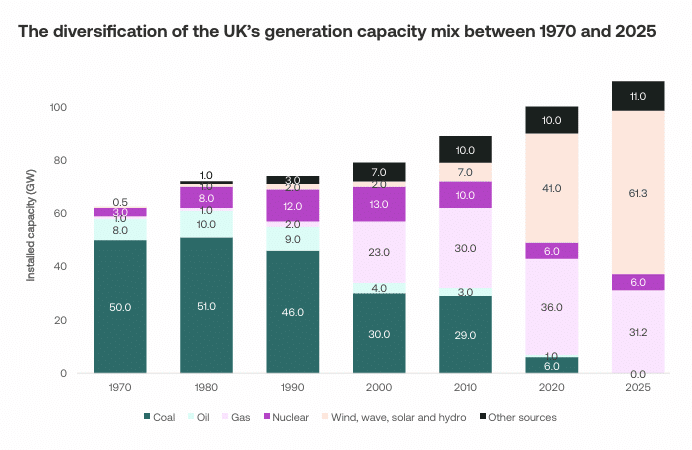
The UK is undergoing one of the fastest power sector transitions in the developed world, moving from coal dependence to completely
phasing it (and oil) out as of 2025 in favour of a diversified lower carbon system built around gas, renewables, and nuclear. The transition of the last c.15 years driven by large-scale renewable deployment, particularly by offshore wind and supported by investment in grids, storage (which increased from c.5GW to c.7.5GW in 2025 alone) and interconnectors underpins the fundamental shift in the supply model. The UK has now reached a position whereby the
country is powered for days on end by renewable energy, and the trend is set to continue with a targeted renewables capacity of 130GW by 2030. However achieving such a target will not only need significant infrastructure capacity, but also tech advancements and adoption to both facilitate the build and operate the outcome.
x
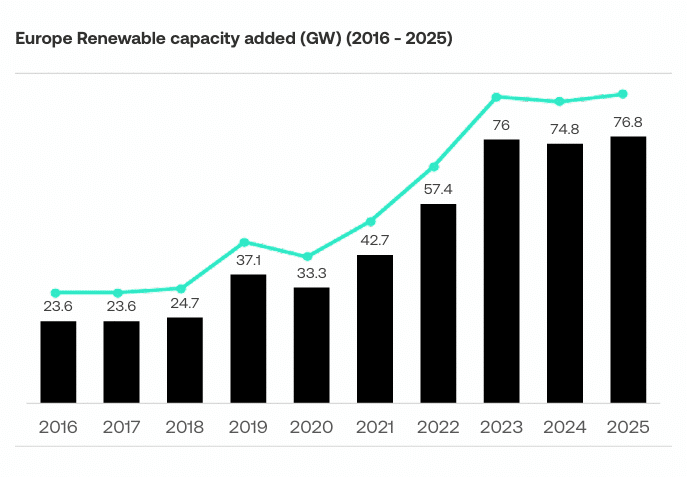
Europe’s renewable energy capacity additions grew significantly between 2016 and 2025, more than tripling over the decade. However, after a period of relatively stable growth through to 2020, growth accelerated significantly, almost doubling from 2021-2023, reaching 76 GW. Growth has remained at similarly high levels through 2025. The result is a system across Europe which is naturally more variable and requires more flexibility, placing emphasis on storage and dynamic demand side response. It has highlighted the need to modernise grid infrastructure to cope with increasingly decentralised energy distribution, including the management of two-way power flows and significant network expansion to transport power from smaller, remote generation sites. All these shifts place a greater emphasis on the need for digitalisation to monitor, manage and automate as far as possible to ensure all assets and platforms work in tandem. EnergyTech advancements have therefore become crucial to balance all aspects of the system from upstream supply through to downstream demand. The catalysts for such an acceleration were macroeconomic in scale.
x
Supply side shocks sparked software
market acceleration
Two major events in 2022, one on the supply side and one on the demand side, accelerated the transition across the UK and Europe.
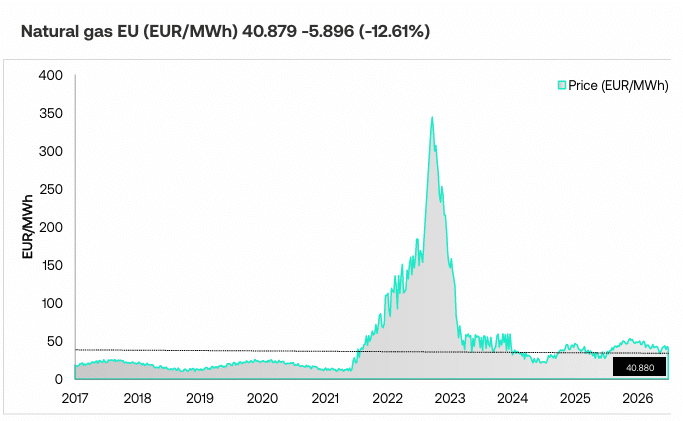
Russia’s invasion of Ukraine triggered the biggest disruption to European energy markets in decades. Before the war, Russia supplied around 40% of the EU’s natural gas imports, leaving Europe highly exposed to supply shocks. As Russian pipeline flows collapsed in 2022, European gas prices surged to record highs – at one point more than 10x historical averages –
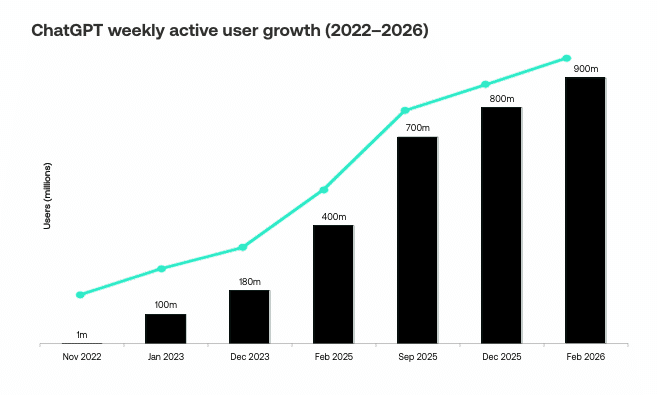
driving electricity prices and industrial energy costs sharply higher (see graph below). The crisis accelerated Europe’s shift toward renewables and energy infrastructure investment. Europe’s renewable capacity additions surged from 42.7 GW in 2021 to 76 GW in 2023, remaining near record levels through 2025 (see graph previous page). In response, the EU launched REPowerEU in 2022 to end dependence on Russian fossil fuels before 2030, accelerating investment in renewables, LNG infrastructure, storage, and grid modernisation. The second market shock came in November 2022, when OpenAI launched ChatGPT which became the fastest growing product of all time in terms of user adoption.
x
x
The launch of ChatGPT in late 2022 significantly increased expectations for data centre and electricity demand growth across Europe. As AI usage grew rapidly, hyperscalers such as OpenAI and cloud providers increased investments in data centres, grid infrastructure, and renewable energy support increasingly power-intensive AI workloads. According to the International Energy Agency, global electricity consumption from data centers is projected to nearly double from 485 TWh in 2025 to 950 TWh by 2030, with AI-focused data center electricity demand expected to triple over the same period. Data centers already account for approximately 1.5% of global electricity consumption, and projections show this could rise sharply as AI adoption scales.
Supply is being rebuilt and demand is racing ahead of every forecast. The intelligence layer between them is where neither side can win without the other and where, as investors, we think the next generation of outliers will be made. This is especially true in the AI build out, where the role of energy in AI is a two-way street:
AI requires immense amounts of electricity to function, but it is also increasingly used to manage and optimise global energy systems. This report speaks to the energy technology trends and companies driving that shift across the UK and Europe.
x
EnergyTech equity investment
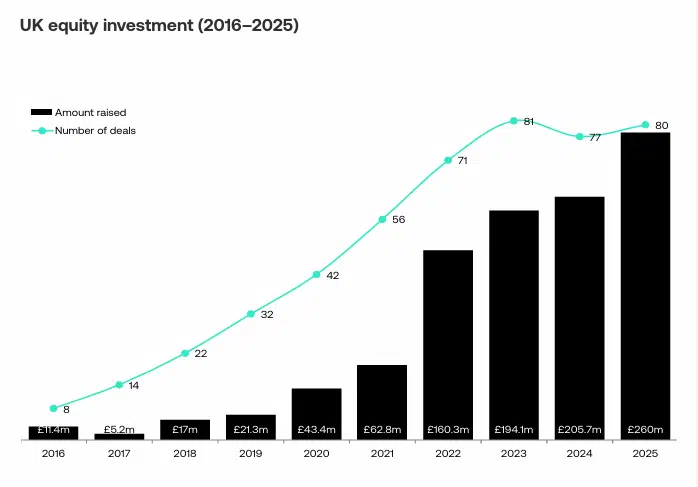
The overall picture of equity investment in the space shows significant growth in deal count and amount raised since 2016 reaching almost £1bn across 483 rounds through 2025. In line with the previously identified general energy market trends, there, has also been a major acceleration in investment from 2021 onwards, when funding more than doubled to £160.3m, bucking the trend of the broader UK VC market, which retreated rapidly following a pronounced pandemic-era spike in 2021. Notable rounds in the space included Fuse and tem, both of which are built on a fundamental value proposition of lowering energy bills for consumers (households in the case of Fuse and businesses in the case of tem), both of which were founded at the time of the energy crisis and both of which have gone on to scale rapidly and raise significant Series B funding from global generalist venture funds. Between 2023 and 2025, whilst the number of deals has remained relatively stable, the amount of equity raised has increased by 34.0%, reflecting a more selective but lucrative
funding environment. This is consistent with early indications of a cohort of emerging winners coming out of an early market, increasingly able to secure larger funding rounds
x
x
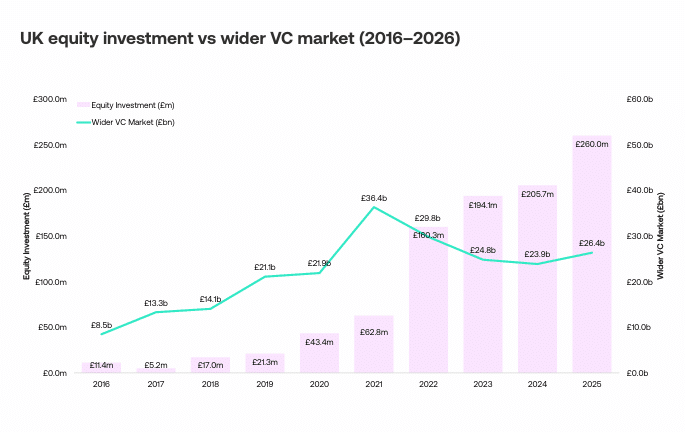
The divergence between EnergyTech and the broader venture market is difficult to ignore. As overall UK equity investment retrenched following the 2021 peak, funding into EnergyTech continued to accelerate, growing from £62.8m in 2021 to £260.0m in 2025. Sectors that continue to attract capital through a market correction are
rarely benefiting from momentum alone, they are typically driven by fundamental shifts in the economy. In our view, EnergyTech has reached that point. The combination of the AI demand boom, electrification, grid transformation and energy resilience is creating sustained demand for new software infrastructure, making this one of
the few areas where investment has strengthened despite a more challenging venture environment.
02
Artificial Intelligence
Equity deals involving AI
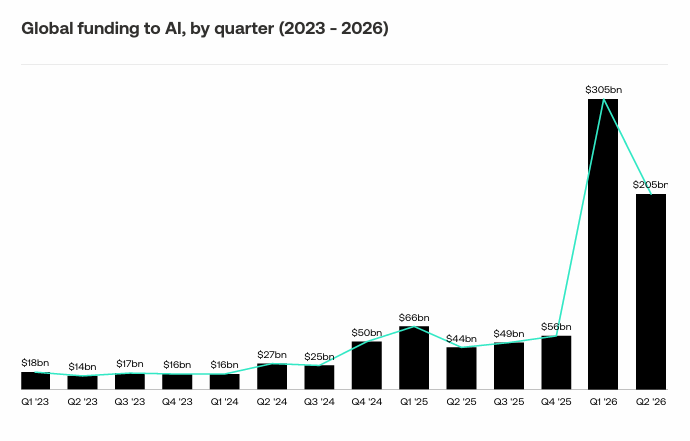
The first half of 2026 was unlike any other for venture investment, driven by unprecedented spending on AI compute and frontier labs. Crunchbase data shows investors poured a record $510bn into startups globally in the first half of the year, up over 150% year over year.
That marks an all-time high for global venture investment not approached by any other quarters on record. In fact, startup investment in Q1 2026 alone totalled close to 70% of all venture capital spending in 2025 and Q2 equals all of H1 2025 ($205bn).
EnergyTech deals involving AI
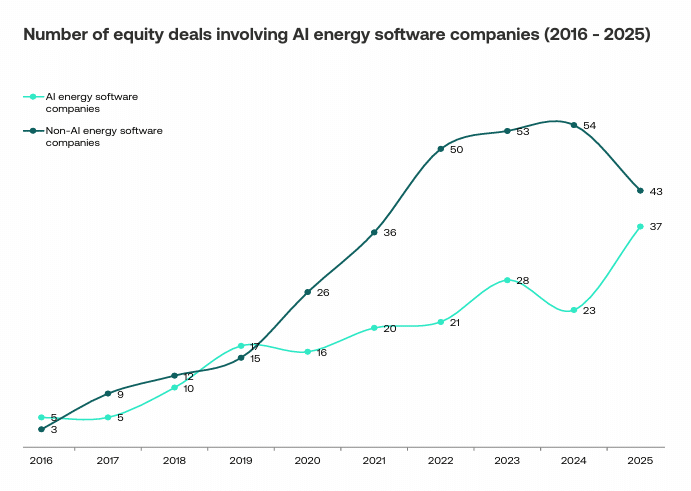
AI is becoming a central feature of the EnergyTech market.
AI EnergyTech deal activity rose sharply in 2025, returning to its upward trajectory after a slight dip in 2024. Non-AI deals peaked in 2024 then fell to 43 by 2025, while AI deals rise from 23 (2024) to 37 (2025). That lifts AI’s share of deals to roughly 46.3% in 2025, its highest since 2019. This pattern fits the broader market where investors have become more selective, but still back propositions tied to AI. However, it also suggests that, whilst the direction of travel is clear and AI is becoming a more central feature of the energy sector, the explosion of startups and widespread adoption across the industry is lagging behind the wider space. Perhaps this is not surprising in an industry which is yet to fully digitalise, but at the same time, the fact that AI technology is going to be imperative in enabling a successful energy transition, indicates that this tipping point is within touching distance. For those AI native companies starting now, that means significant blue ocean to go after. For an investor, the fact that there’s still such opportunity to be captured is grounds for extreme optimism.
“Cement and steel plants run some of the most complex, carbon intensive industrial processes on earth, and most of the software managing them was built decades before AI existed. Our Self-Learning Control unifies AI control and AI optimisation to actually run the plant, learning from it and adapting in real time. We are already saving our customers up to $1.3 million and tens of thousands of tonnes of CO2 per site, per year, and demand is being driven by hard economics, which is why our customers are adopting it now. We’re still at the start of what this can do across energy intensive industry, but we’re in it for the gigatons, which is what makes it such an exciting space to be in.”
Buffy Price, Co-founder, Gigaton
03
Companies
Top investment recipients
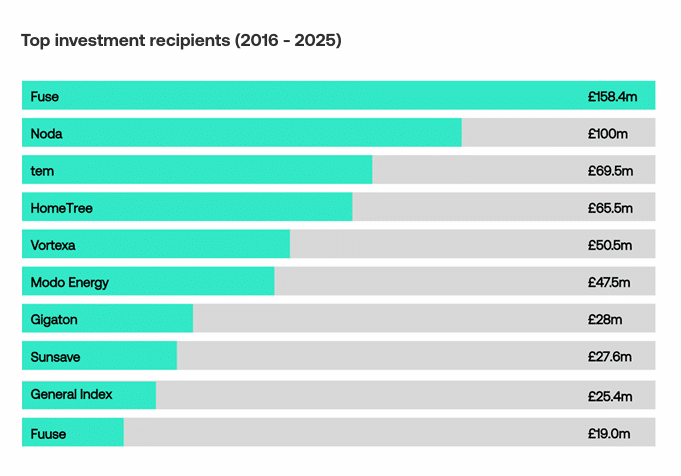
The top investment recipients chart highlights both a concentration of capital flowing into a small number of EnergyTech companies, but
also a relative immaturity with overall quantums dwarfed relative to other high profile spaces. The vast majority of funding (with numbers in the trillions) has been invested on the physical assets/infrastructure part of the space. The larger funding amounts on the asset-lite side of the space are geared towards companies which can manage, monetise and increase the efficiency (and therefore reduce the price) of these assets. Fuse is notable as its model is to vertically integrate and therefore also includes physical generation assets. However, the company’s proposition is underpinned by proprietary software enabling real-time optimisation of energy procurement pricing, and distribution. tem is another example of a high-growth platform that is rebuilding the transaction layer of the electricity market. Its AI-native platform allows businesses to buy power directly from renewable generators, stripping out the layered intermediary fees that traditionally sit between buyers and sellers in the wholesale market, delivering cost savings of up to 30%.
x
Investors backing outlier companies
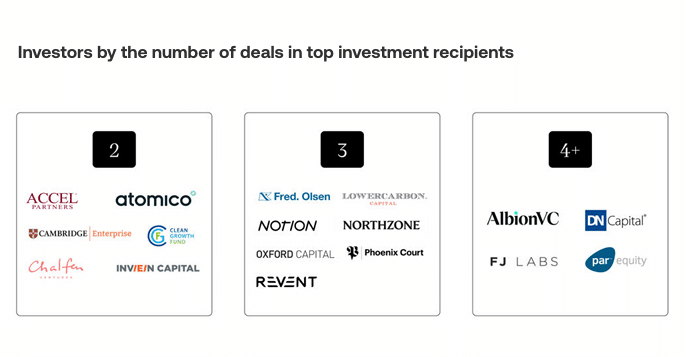
The investor base backing the cohort’s leading breakouts are distinct from the ones funding the broader market. The top recipient companies
include a cluster of global growth-stage names:
Atomico, Accel Partners, Lowercarbon Capital, Northzone Ventures, Notion Capital, Phoenix Court and Lightspeed Venture Partners among them. The wider investor set is more diverse, including EIS-focused funds and public bodies that build depth at seed and early stage. The two views showcase a typical early market structure with fragmented support for emerging technologies in this space. Global investors have so far tended to enter at slightly later stages, reflecting their position further
up the experience curve. Their focus has been on supporting the breakouts at scale but with limited commitment at the earlier stages. We believe this will change as the first winners show what can be achieved and the scale of opportunity becomes apparent.
x
“We’re now at a point in history where cost of the electron is setting the pace of markets everywhere. Rebuilding the infrastructure behind how energy is priced and passed onto businesses is a global undertaking, and we’ve built a cap table and AI-native platform to match those ambitions. AlbionVC backed us early with deep sector expertise and hands-on operating support, Atomico enabled fast growth in the UK, and our latest Series B led by Lightspeed is supporting us to take our mission truly global.”
Joe McDonald, CEO & Co-founder, tem.
Most active investors
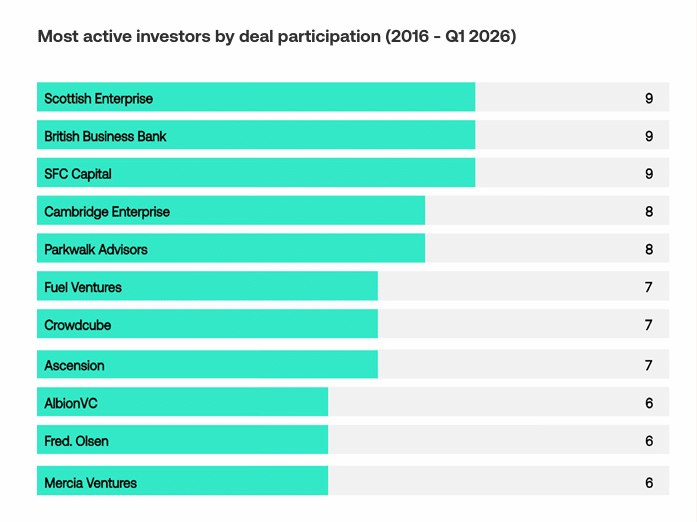
The investor base across the broader EnergyTech cohort reflects a broad mix of capital providers, spanning venture funds, corporate investors and public bodies. The presence of EIS-focused backers such as SFC Capital and Parkwalk Advisors, alongside regional and publicly supported organisations such as Scottish Enterprise and the British Business Bank, underlines the role of UK tax-efficient capital and local ecosystem funding in supporting early-stage EnergyTech businesses. This is consistent with the cohort’s funding profile, where smaller rounds account for a significant share of activity. Unlike more capital-intensive technology models, software-led propositions typically require lower upfront investment and can reach proof of concept with comparatively lower deal sizes. Together, the mix of seed, public and venture capital reflects a funding ecosystem capable of supporting businesses from early development through to infrastructure-scale deployment.
x
“At AlbionVC, we look for founders solving complex infrastructure problems in markets undergoing structural change, which is exactly what we’re seeing in energy today. The most exciting companies in this space are combining deep technical and commercial understanding of the energy system with the product and software mindset that transformed sectors like fintech. We still believe we are in the early innings of the market, and the scale of the transition ahead makes this a uniquely compelling time to be investing in early-stage EnergyTech and infrastructure.”
Adam Chirkowski, Partner, AlbionVC
“The energy sector has been at the forefront of development of AI applied software and the UK has a distinctive ecosystem of companies benefitting from a convergence of local skills and a supportive market environment for the adoption of innovation. The solutions address large market challenges across the full energy sector lifecycle – from the acceleration of development of new energy assets to creating new AI-native challenger energy producers, traders and asset operators. At the British Business Bank, we aim to support the next generation of high growth UK companies including via our direct investments, supporting specialist funds and helping to crowd in private capital. Having joined the Bank as an experienced energy sector professional, I am also focussed on supporting these companies to succeed
through my experience and network.”
Rachael Reid, Senior Investment Manager and Clean Energy Sector Lead,
British Business Bank
04
Exits
Exits in UK EnergyTech market
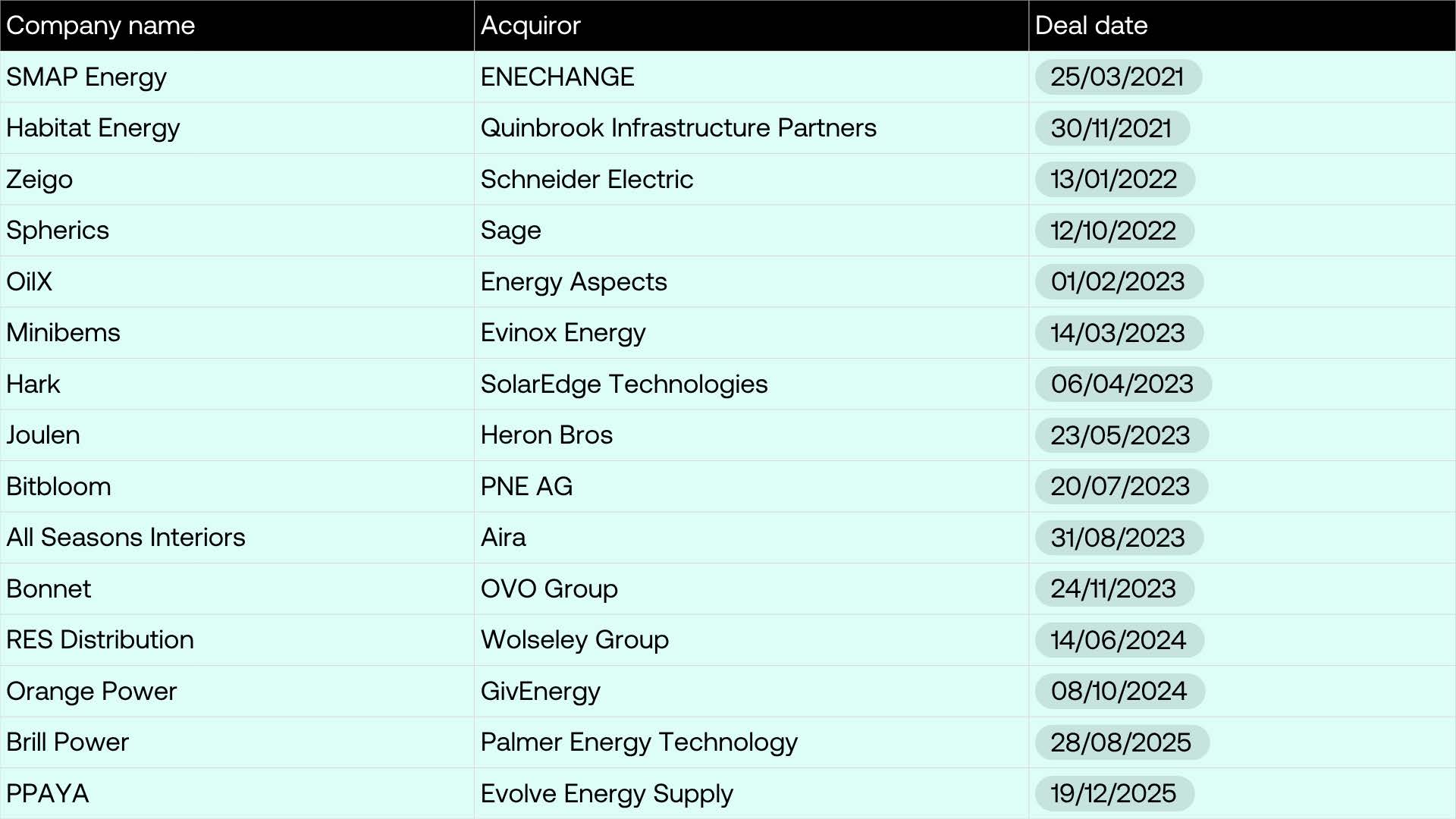
Across the limited observed exits over the past 5 years, the EnergyTech segment is in line with the profile of an area which is still in its infancy with segmental consolidation and significant volumes of big ticket
M&A activity still to come.
- Numbers are limited so far
The number of exits has been relatively limited over the period, these provide further evidence of a market made up of a relatively young cohort of companies with no outlier exits. - Strategic acquirers dominate
Thirteen of fourteen exits were to corporate buyers, with only one transaction involving a financial sponsor (Quinbrook Infrastructure
Partners acquiring Habitat Energy). This overwhelming skew indicates that they have predominantly been bolt-on acquisitions, rather than a core platform investment. - Broadening buyer universe beyond energy incumbents
Acquirers for UK assets are frequently international with buyers from Japan, France, Germany, Sweden, and Israel. This illustrates not
just international buyers using UK energy software companies as entry points into the UK, but also the portability of UK technology to European markets and beyond. Given the UK’s energy system remains one of the most advanced in the world, it is one of the country’s clear advantages in the transition and highlights the region’s role as an innovation hub in EnergyTech
05
Summary
Building the next wave of UK energy tech
It’s clear that the impact of energy on the global economy over the next decade cannot be understated. From the AI revolution to the local school, the cost of the electron will impact all in an increasingly pervasive way. The acceleration of the energy transition, over the past 5 years in particular, is causing a paradigm shift; disrupting an antiquated system and creating value opportunities which technology advances are perfectly placed to benefit from. It is not simply a push towards a greener, more sustainable future for the planet, but also a push towards improving the health of P&Ls for companies everywhere.
Such a global overhaul puts market sizes in the trillions. As a result, EnergyTech companies which are being started now have the opportunity to move the needle globally by designing, building and operating the system fit for the next century. It is now up to UK founders and investors to seize these opportunities on a greater scale than has been done to date.
Currently the space is in the infancy, as detailed by the indicators in this report, and so far overlooked vs the markets it is helping to underpin which have received the lion’s share of the spotlight. Equity investment profiles of the segment point to a nascent space which is still finding its feet. However, when you look at the profile, size, defensibility and blue ocean available it is a space that we predict is on the cusp of garnering significantly more attention sooner rather than later, especially when the early winners start to make their mark on the global stage.
An increasing proliferation of game-changing founders is what is now required and what we’re starting to see. Those that have experienced success and the scaling journey in adjacent sectors, combined with exceptional technical talent and those that have deep domain expertise to understand the current set up and the vision to re-imagine what is now possible to disrupt it. It is a combination that is uniquely placed to create generational companies as those early winners have shown. It is also a combination that is becoming less rare since the explosion of EnergyTech following macroeconomic events in 2021 and 2022.
With the rise of AI having taken centre stage over the last few years, energy is now moving more into the spotlight. With its impact reaching far beyond just LLMs and datacentres, we believe it will not be long before it is EnergyTech’s time to shine in its own right.
Methodology
EnergyTech cohort
The companies included in this report were identified using Beauhurst’s proprietary industry tagging and AlbionVC’s research, ensuring that companies developing or manufacturing hardware or tech were
excluded. A 10-year limit on company age is applied, only including companies incorporated between 1st January 2016 and 31st December 2025.
Core criteria for companies:
- UK HQ
- Founded in or after 2015
x
Equity Investment
To be included in our analysis, any investment
must be:
- Some form of equity investment, and
- Issued between 1st January 2016 and 31st
December 2025 - Data was collected on the 27th March
2026 from the Beauhurst platform
